What is an AI-native operating system?
By Hevolve AI · Updated 2026-07-21
An OS where the model is a system service rather than an app you open. It probes what the hardware can actually run, serves language, vision and speech to every application over a shared bus, and adapts itself to the machine instead of asking the machine to meet a spec.
The difference from 'an OS with AI in it'
Most systems described as AI-powered ship an assistant: a separate application, usually talking to somebody else's server, that can drive a few OS functions. The operating system underneath is unchanged. Remove the assistant and everything still works the way it did.
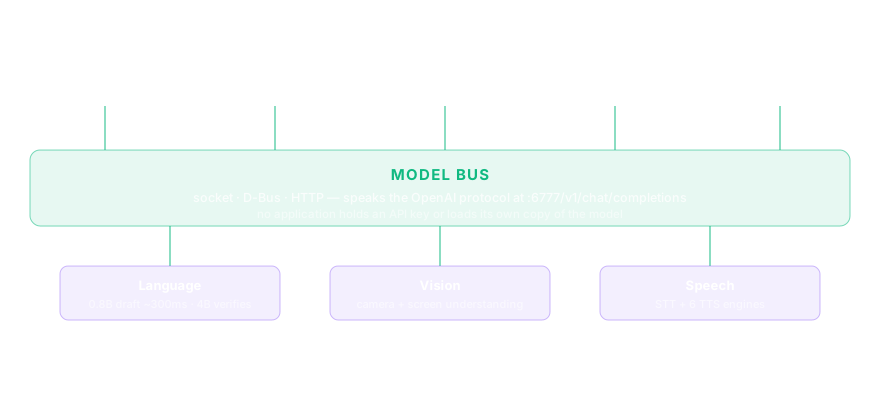
AI-native inverts that. Inference becomes a service the system provides, the way it provides a filesystem or a network stack. An application does not bundle a model or hold an API key. It asks the OS, and the OS decides which model answers, running locally where it can. In HART OS that service is the Model Bus, reachable over a socket, D-Bus or HTTP, and it speaks the OpenAI protocol at :6777/v1/chat/completions so existing code can point at it without being rewritten.
The practical consequence is that the model is shared. Ten applications on one machine do not each load their own copy or each pay their own API bill.
Adapting to the machine, not the other way around
The word native is doing real work in that phrase. The system probes what the device can genuinely do and picks accordingly, rather than publishing a minimum spec and refusing anything below it. Heavy speech engines are skipped on cards with 6GB or less. A 0.8B draft model answers in roughly 300ms while a 4B model verifies behind it, so a consumer laptop feels like a hosted API rather than a compromise.
This is where a research corpus stops being decorative. Whether a capable model fits on ordinary hardware is an active field: quality-aware weight quantization for serving mixture-of-experts models, extreme low-bit compression, distillation that transfers behaviour rather than weights, and inference accelerators that move the floor itself. An AI-native OS is a bet that this line keeps moving, and a design that benefits automatically when it does.
One runtime, three shapes, including robots
The same Python codebase runs flat on a single laptop with SQLite, regional across a LAN, or central as a cloud mesh, with the topology detected rather than configured into a separate product. The runtime that drives a desktop also drives embodied hardware, so a robot's access to language and vision is another Model Bus call rather than a parallel stack somebody has to maintain.
That matters more than it sounds. Most of the cost in this space is not the model, it is maintaining four integrations of the same capability for four form factors.
What we would not claim
AI-native is close to meaningless as a marketing word, so it is worth separating what is load-bearing from what is not. The parts that exist as code are the hardware probing, the shared bus, the OpenAI-compatible endpoint, the topology detection, and a guardrail hash re-verified every 300 seconds alongside Ed25519 release signing.
The learner that improves across the network is a signed, closed-source native component loaded at runtime. When it is absent the system runs safe no-op fallbacks. We would rather say that plainly than let an architecture diagram imply more than is shipping.
The research this is based on
6 papers, each explained in plain language.
PagedWeight: Efficient MoE LLM Serving with Dynamic Quality-Aware Weight Quantization
arXiv (cs.LG)BiSCo-LLM: Lookup-Free Binary Spherical Coding for Extreme Low-Bit Large Language Model Compression
arXiv (neural decoding)On-Policy Delta Distillation
arXiv (cs.LG)NIFA: Nonlinear IMC enhanced FPGA for efficient ML inference
arXiv (cs.AI)DPNeXt: A Lightweight Multi-Scale Feature Fusion Framework for Efficient ViT-Based Multi-Task Dense Prediction
arXiv (cs.AI)LLM-Powered Agentic AI for 5G/6G Networks: A Tutorial and Survey on Architectures, Protocols, and Standardization
arXiv (cs.AI)Ask this yourself, on your own hive
This answer was assembled by a Hevolve agent from cited research. You can run agents like it locally — build them by talking, keep your data on your own machine.