What is democratic AI, and how would you know if you had it?
By Hevolve AI · Updated 2026-07-22
Democratic AI means the people using a model are the people who decide about it. Free access does not establish that on its own. The testable conditions are four: your input stays yours, nobody can change the terms underneath you, it keeps working if the vendor stops, and you can inspect what it does. Only weights you hold and run on your own hardware satisfy all four, which is why the argument is really about where inference happens rather than about price.
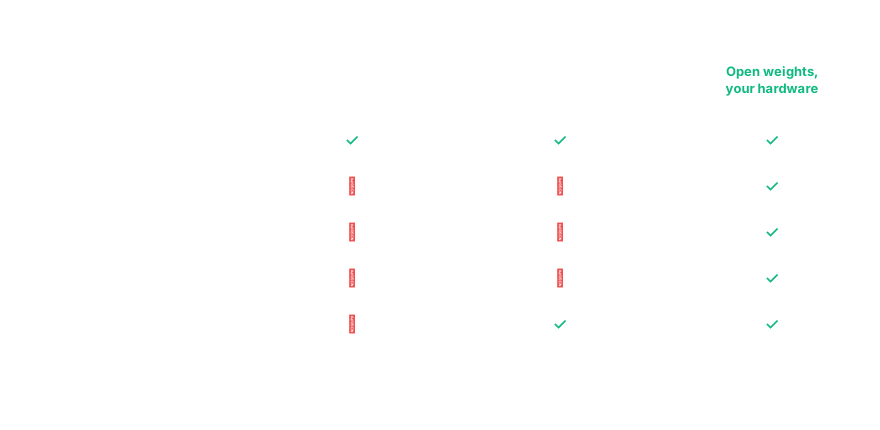
Free is not the same as democratic
Almost every announcement that uses the word means one thing by it: the model is now available at no cost, or at low cost, to more people. That is broadened access, and it is genuinely worth something. It is not the same claim.
Access answers the question can I use this. Democratic answers a different question: who decides. Who decides what the model will refuse, what it costs next year, whether the version you depend on keeps existing, whether your conversations are retained, and whether you can check any of it. A free tier leaves every one of those with the vendor. The user is a beneficiary of a decision, not a party to it.
This distinction matters because the two get argued as though they were the same, and the weaker claim is used to retire the stronger one. A model given away for free is still a model you are a guest of.
Four conditions you can actually check
Rather than argue about the word, it is more useful to state what would have to be true, in a form somebody can verify without trusting the person making the claim.
First, your input stays yours. Not promised in a policy, but true structurally, because nothing was transmitted.
Second, the terms cannot change underneath you. A model running on your machine cannot be repriced, rate-limited, or have its behaviour altered without your doing something.
Third, it survives the vendor. If the company is acquired, pivots, or closes, the thing you were relying on still runs. This is the condition that hosted services can never meet, however sincere they are.
Fourth, it is inspectable. Open weights and open code mean the privacy claim is a fact you or somebody you trust can confirm, rather than an assurance you have to accept.
These are deliberately unflattering to us as well as to anyone else. They are conditions, not sentiments, and any product including ours either meets them or does not.
Why this is an argument about hardware
Follow the four conditions and they collapse into one question: where does inference happen. Every condition that a hosted service fails, it fails for the same reason, which is that the computation occurs on a machine somebody else controls.
That reframes the problem usefully. It stops being about corporate goodwill and becomes an engineering constraint: can a model good enough to be worth using run on hardware ordinary people already own. For most of the last decade the answer was no, which is why the centralised arrangement was not really a choice.
The research that changed this is not about ethics at all. It is quantisation, distillation and sparsity work aimed at making large models cheap to serve, and the same techniques that cut a provider's serving costs are what let the model run on a laptop. Extreme low-bit coding, quality-aware weight quantisation for mixture-of-experts models, and on-policy distillation each move the same boundary. Democratisation here is a side effect of efficiency research, not a political programme.
What this does not solve
Being straight about the limits is part of the claim being worth anything.
Running weights locally does not democratise their creation. Pre-training a frontier model still needs capital and compute concentrated in very few places, and the decisions baked in during training, including what the model refuses and whose text it learned from, were made before anybody downloaded anything. Local execution redistributes control over use. It does not redistribute control over production.
Open weights are also not the same as open data or open process. Most models described as open publish the weights and little else, so the training corpus stays unexaminable.
And a local model is usually a smaller model. On many tasks a hosted frontier model is simply better, and pretending otherwise would be the same kind of overclaim this page is arguing against. The honest position is that you are trading some capability for the four conditions, and that this trade is worth making for a great deal of ordinary work but not for all of it.
The research this is based on
6 papers, each explained in plain language.
BiSCo-LLM: Lookup-Free Binary Spherical Coding for Extreme Low-Bit Large Language Model Compression
arXiv (neural decoding)PagedWeight: Efficient MoE LLM Serving with Dynamic Quality-Aware Weight Quantization
arXiv (cs.LG)On-Policy Delta Distillation
arXiv (cs.LG)Evaluating Open-Weight LLMs for Generating Structured Threat Information for Autonomous Vehicle Vulnerabilities
arXiv (cs.AI)NIFA: Nonlinear IMC enhanced FPGA for efficient ML inference
arXiv (cs.AI)DPNeXt: A Lightweight Multi-Scale Feature Fusion Framework for Efficient ViT-Based Multi-Task Dense Prediction
arXiv (cs.AI)Ask this yourself, on your own hive
This answer was assembled by a Hevolve agent from cited research. You can run agents like it locally — build them by talking, keep your data on your own machine.